
The True Meaning of Christmas
By Joseph P.

Nativity Scene with Manger and Wooden Cross by TrueCreatives Created in Canva
Christmas is an ancient holiday with both religious and secular roots that stretch back centuries. In modern times, though, it is often seen as synonymous with presents and Santa Claus. Modern consumerist trends have caused society to view it as a holiday more about receiving than giving. But does this interpretation hold up to the Christian purpose for celebrating Christmas, and if not, what is the true meaning of Christmas?
Societal Misconceptions
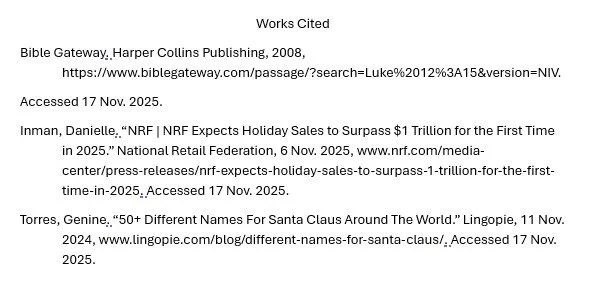
Advertisements, cultural traditions, and material desires hold significant influence in our society. Companies leverage appealing promotions and marketing campaigns to get people to buy more during the holiday season, usually by discounting “old” items and by convincing us we need the latest and greatest products, no matter the financial cost. Popular holiday figures such as Santa Claus have been around for centuries, and he is often prominently depicted in holiday advertisements due to his widespread recognition in one form or another worldwide (Torres). These aggressive, highly effective marketing strategies often lead to a significant spike in consumer spending toward the end of the year. According to the National Retail Federation's annual forecast, holiday spending in the United States alone is expected to exceed $1 trillion for the first time ever (Inman). But while businesses profit, it can be easy for even Christians to lose sight of the fact that the true meaning of Christmas is not about receiving temporal gifts.
A Christian Perspective
In the Bible, Jesus warns against greed. Luke 12:15 says: “Then he said to them, 'Watch out! Be on your guard against all kinds of greed; life does not consist in an abundance of possessions’” (Bible Gateway). While it is not necessarily harmful to shop for gifts during the holiday season and to include items of cultural significance in our celebrations, it is essential to remember that the true meaning of Christmas has nothing to do with growing richer materially. In fact, it is quite the opposite. When Christians celebrate Christmas, we recognize the birth of Jesus Christ, and we honor the divine gift of salvation that His birth represents. This is comparable to Easter, or Resurrection Day, which is not about the Easter Bunny but about remembering the sacrifice that Jesus undertook by dying on the cross to save us from our sins. Both these holidays have secular traditions that we often incorporate into Christian ones, but their proper significance for Christians is in their biblical roots. When we center ourselves in the Word and use Jesus as a foundation for our celebrations, we find that His birth represents the true meaning of Christmas.
Columns: 🗓️Seasonal, ✝️Spiritual Life
Joseph P. lives in Phoenix, USA, with his parents and an older sibling. This is his second year writing at the Navigator, but his fourth year at NorthStar. In his free time, he enjoys watching the birds in his backyard, playing video games, and reading books. In the future, he aspires to become a computer hardware engineer.